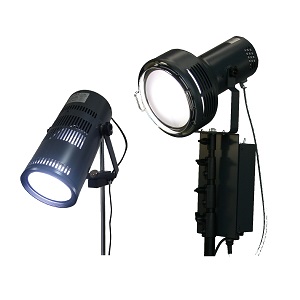
XELIOS XG-Series Super Spotlight

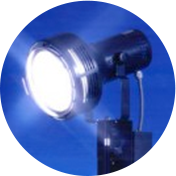
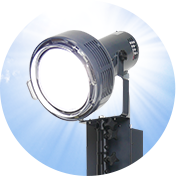
Two XELIOS XG-Series Super Spotlight artificial solar lighting units with black lamp housings.

Light-Concentrating Artificial Solar Lighting

Artificial Sunlight for High-Irradiance and High-Illuminance Testing

The XELIOS XG-Series Super Spotlight concentrates artificial sunlight for evaluation and testing. EFSS models are specified for 1 sun (1,000 W/m²) irradiance, while AFSS models are specified for 100,000 lux illuminance. Select the model group based on the measurement conditions your application requires.

The standard Super Spotlight configuration is designed for either 1 sun or 100,000 lux, not both at the same time. If your test requires both conditions, contact SERIC to discuss a fully customized system.
XELIOS Super Spotlight at a Glance

Start with the light measurement your test requires: irradiance (W/m²) or illuminance (lux). These are different measures and should not be treated as interchangeable.
For Irradiance-Oriented Testing
1 sun (1,000 W/m²)
Models: XG-100EFSS / XG-500EFSS
At the stated 1 sun condition, the listed EFSS models provide approximately 60,000 lux of illuminance.
For High-Illuminance Evaluation
100,000 lux
Models: XG-100AFSS / XG-500AFSS
The listed AFSS models are configured for 100,000 lux of illuminance.
The standard configuration cannot provide 1 sun and 100,000 lux simultaneously. Contact SERIC if both conditions are required.
This is a selection overview, not a complete numerical specification table. Confirm test area, irradiation distance, light distribution, and other conditions with SERIC.

Primary Applications

The appropriate Super Spotlight model depends on the evaluation objective. The examples below reflect the model associations shown on SERIC’s Super Spotlight page.
  • EFSS: Irradiance-Oriented Testing
    Models: XG-100EFSS / XG-500EFSS
    • Development and evaluation of LiDAR for autonomous driving systems.
    • Development and evaluation of ADAS sensors and cameras.
    • Simple evaluation tests for solar cells.
    • Light-resistance tests for sensors and components.
    • Temperature-rise tests for products and materials.
    • Thermal-insulation tests for products and materials.
    • Thermal-load tests for products and materials.
  • AFSS: High-Illuminance Evaluation
    Models: XG-100AFSS / XG-500AFSS
    • Visibility evaluation of smartphone displays.
    • Visibility evaluation of in-vehicle displays.
    • Camera backlight reproduction.
    • Evaluation of luminance unevenness in the field of view of an in-vehicle camera.
  • BFSS: UV-Resistance Testing
    Models mentioned in the current use-case list: XG-100BFSS / XG-500BFSS
    • UV-resistance testing of products and materials.
    Contact SERIC to confirm the appropriate configuration and test conditions for UV-resistance applications.
Other applications may include natural sunlight simulation; suitability should be discussed in the context of your test requirements.

Key Features

High-Intensity Light
Concentrated artificial solar lighting for tests requiring high light intensity.
High-Energy Light
A concentrated light source for evaluation applications requiring high light energy.
Near-Parallel Light with the Applicable Filter
Near-parallel light can be produced when an ASS, ESS, or BSS transparent filter is used.
Filter suitability and supplied configuration should be confirmed with SERIC. The transparent filters must not be represented as included by default.

Application Example — Mizuno WAVE LIGHTREVO

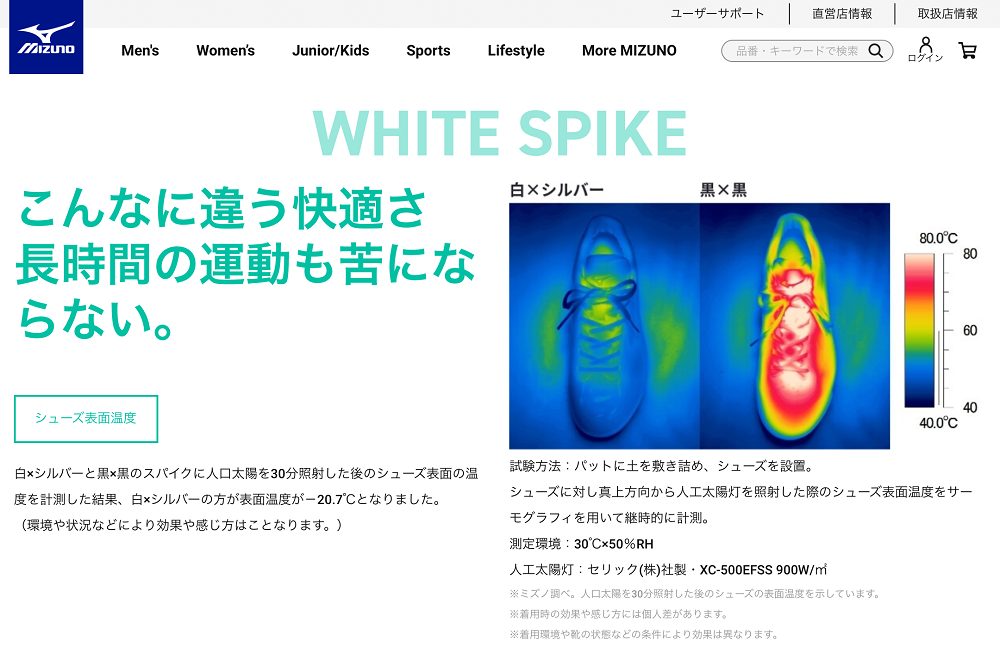
Surface Temperature Evaluation of Baseball Cleats

SERIC’s artificial solar lighting was used in Mizuno’s WAVE LIGHTREVO shoe surface temperature visualization experiment. Artificial sunlight was directed onto baseball cleats indoors, and changes in surface temperature were recorded using thermography.

The experiment used an XG-500EFSS at 900 W/m² under the conditions described in the case study. This is a test-specific setting, not a general rated specification for every Super Spotlight installation.
The model is referred to as XC-500EFSS in the Japanese market; the current English product page states that its performance is the same as XG-500EFSS.
Mizuno WAVE LIGHTREVO thermography comparison of white-and-silver and black baseball cleats after simulated sunlight exposure.

Light Distribution (Reference Example)

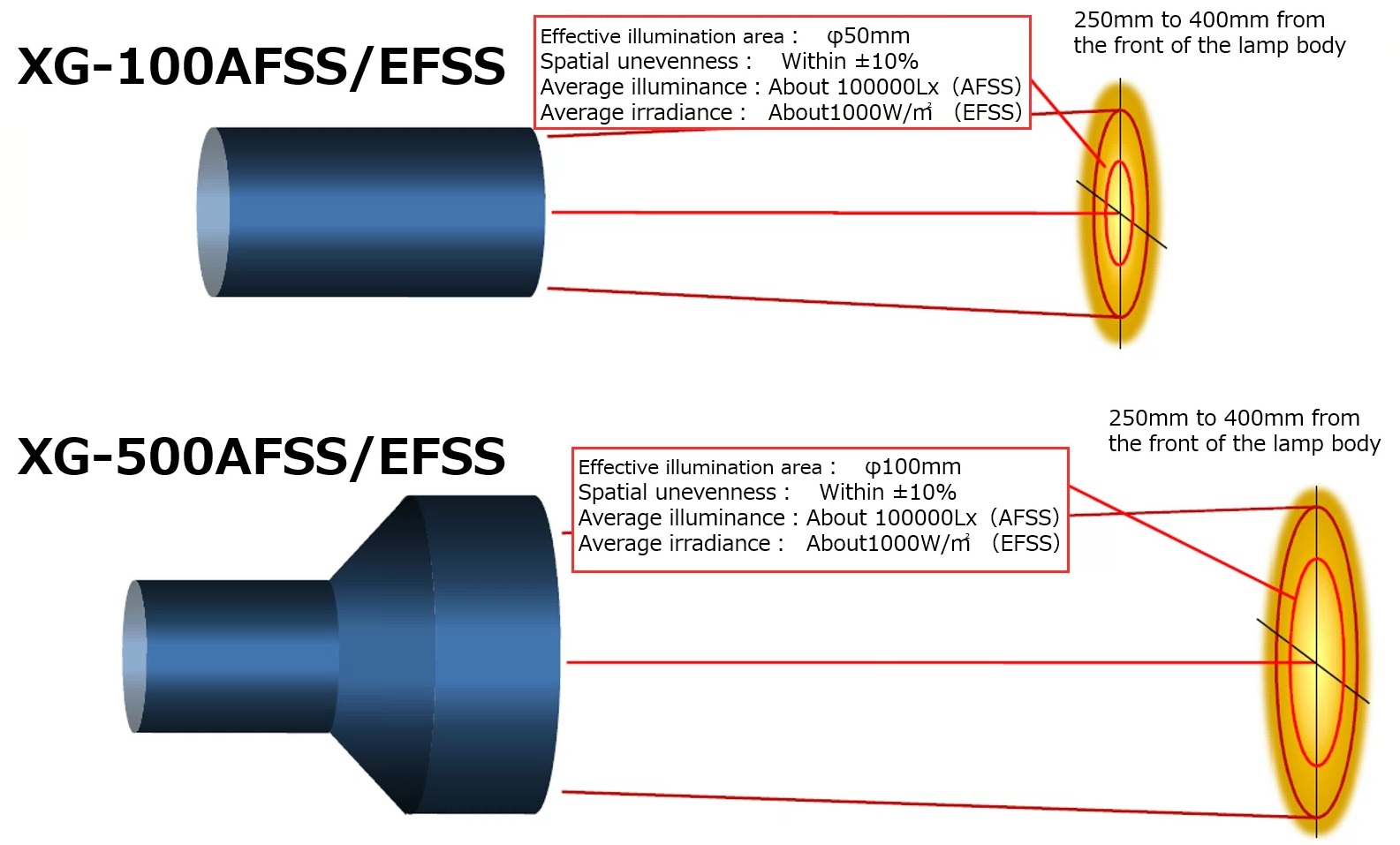
The original diagrams illustrate representative light-concentrating configurations for the XG-100AFSS/EFSS and XG-500AFSS/EFSS model groups.
Diagrams of XG-100AFSS/EFSS and XG-500AFSS/EFSS Super Spotlight light distribution and example irradiation areas.

Reference light distribution illustrations for the XG-100 and XG-500 Super Spotlight configurations. Confirm irradiation area, distance, and measurement conditions for your application.
  • The standard concentrating-type unit cannot provide 1 sun (1,000 W/m²) and 100,000 lux simultaneously.
  • Measurements for XG-100AFSS/EFSS are described as five-point measurements according to SERIC’s internal standards.
  • Measurements for XG-500AFSS/EFSS are described as 17-point measurements according to SERIC’s internal standards.

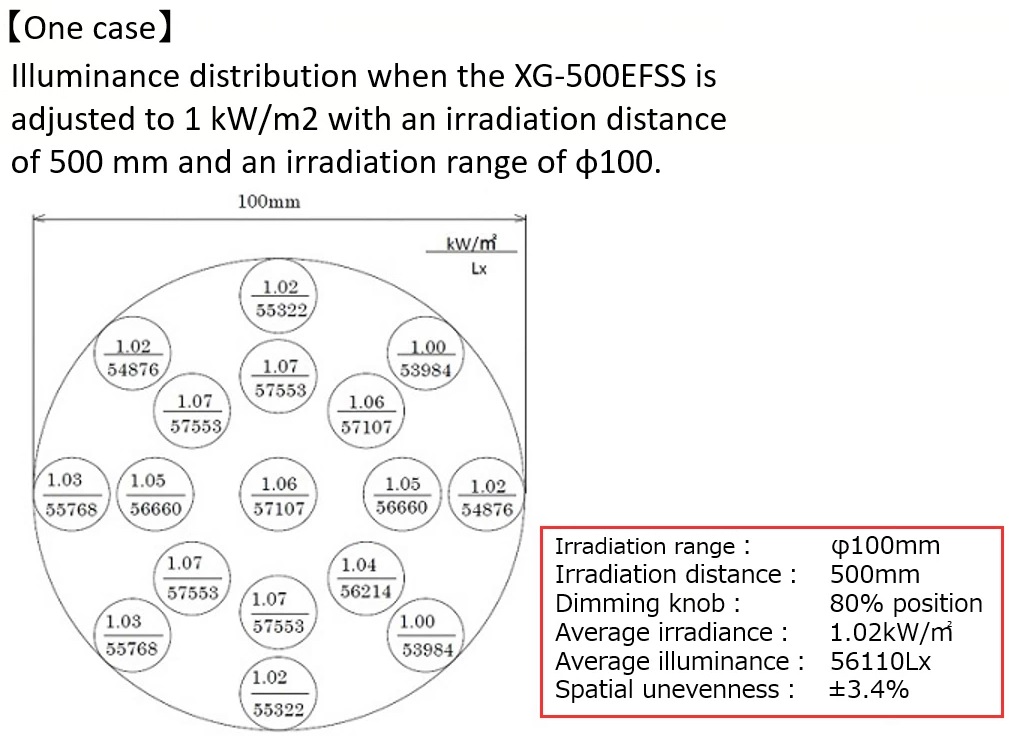
Illuminance Distribution (Example)

This original distribution chart illustrates a specific XG-500EFSS test condition. It is provided as an example for evaluating how irradiation conditions relate to the target area.
Example XG-500EFSS illuminance distribution chart showing measurement points across a circular test area.

Example illuminance distribution for XG-500EFSS, with the test arrangement and measurement values shown in the original figure.
Values shown in this example are tied to the illustrated test setup and should not be presented as a guarantee for all configurations.

Discuss Your Irradiation Requirements

SERIC can review the intended application and discuss lighting adjustments or a custom configuration. Providing the following details, when available, will help clarify your requirements.
  • What product, material, sensor, or system will be tested?
  • Is your priority a target irradiance (W/m²) or illuminance (lux)?
  • What irradiation area and working distance does the test require?
  • Are there installation or test-environment constraints?
  • Are specific spectral or filter conditions relevant to the application?

These are preparation questions, not a form or a requirement to provide every detail before contacting SERIC.

Frequently Asked Questions

  • Can a standard Super Spotlight provide both 1 sun and 100,000 lux?

    No. A standard concentrating-type system is configured for one of these conditions, not both simultaneously. If both are required, contact SERIC to discuss a fully customized device.
  • Which models are listed for 1 sun irradiance?

    XG-100EFSS and XG-500EFSS are listed for 1 sun (1,000 W/m²) irradiance. Under this condition, the illuminance is approximately 60,000 lux.
  • Which models are listed for 100,000 lux?

    XG-100AFSS and XG-500AFSS are listed for 100,000 lux illuminance. This is a different target from 1 sun irradiance.
  • Can SERIC adjust the irradiation conditions?

    SERIC reviews the intended use and irradiation requirements before shipment and can discuss adjustments or customized equipment. The suitable configuration depends on the application and conditions.
  • Which Super Spotlight models are mentioned for UV-resistance testing?
    The current Super Spotlight product page lists XG-100BFSS and XG-500BFSS as examples for UV-resistance testing of products and materials. Contact SERIC for applicable model specifications and test conditions.

Discuss Your Super Spotlight Test Requirements

Tell SERIC about your intended evaluation, required irradiance or illuminance, and any relevant irradiation or installation conditions. Our team can discuss an appropriate lighting configuration for your application.